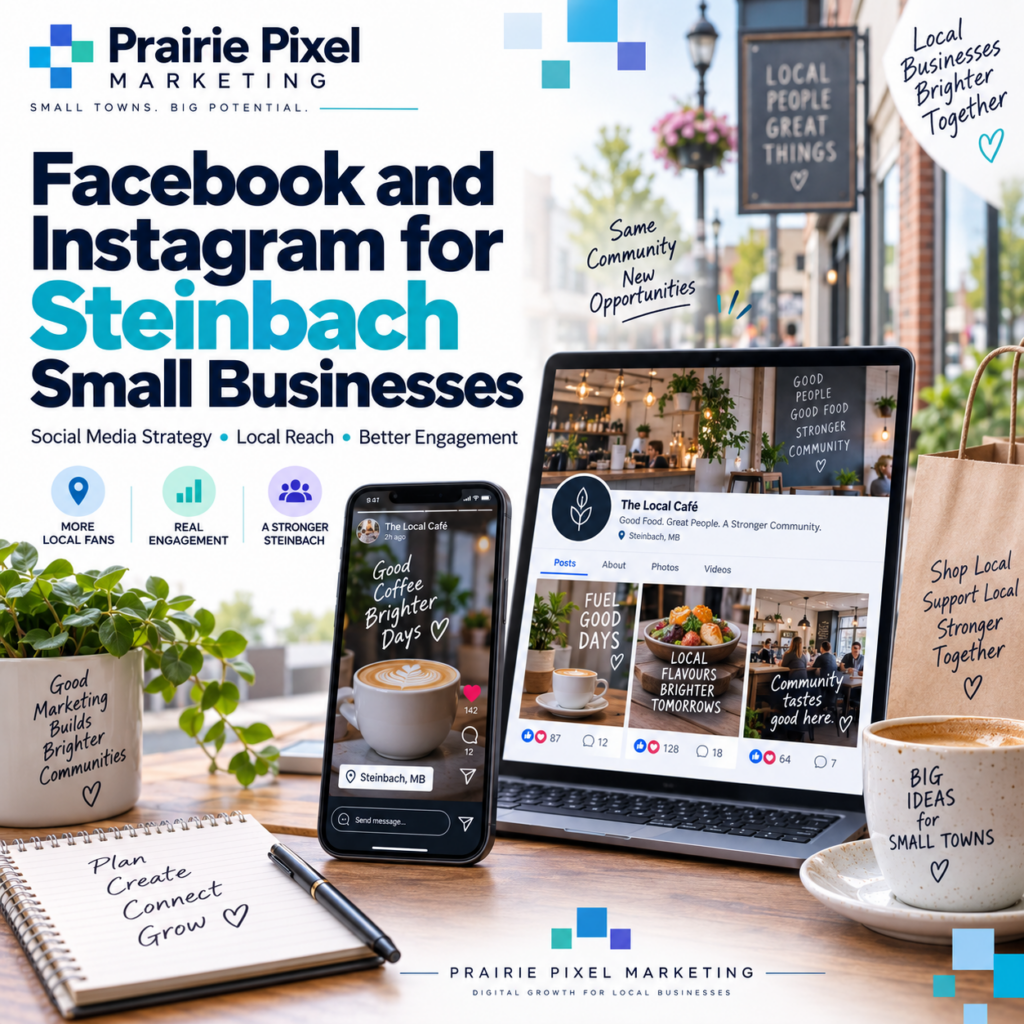
In a town the size of Steinbach, Facebook is not really social media. It is the community noticeboard. Local buy-and-sell groups, community pages and event listings do more to spread word about a business here than anything an advertising agency could design.
That changes what social media is for. In a city, social is a broadcast channel. In a town of eighteen thousand where a good share of the population is in the same handful of Facebook groups, it is closer to word of mouth with a reach button attached.
Which platform to start with
Facebook, almost always, for a business in this region.
The audience is broader and older than Instagram’s, community groups are where local recommendations actually happen, and events, hours and messaging all work well without extra effort.
Instagram earns its place when your work is visual — food, hair and beauty, renovations, trades with dramatic before-and-afters, retail with attractive stock. If your product photographs well, Instagram gives it a second life.
Both, only if you can genuinely keep both going. One account posted to consistently beats two that go quiet for six weeks. A dormant account is worse than none, because it tells visitors the business may have closed.
How often to post
Less than you have been told.
For most small businesses here, once or twice a week, indefinitely, beats daily posting for a month followed by silence. Consistency is what builds familiarity; volume mostly builds fatigue in whoever has to produce it.
What is worth posting:
- Finished work, with a sentence about what the job involved
- Staff and the day-to-day of the business — small towns buy from people
- Genuine changes: new stock, seasonal hours, a new service
- Answers to questions customers actually ask
- Local involvement: sponsorships, events, community things
What is not worth posting:
- Motivational quotes on stock backgrounds
- Generic holiday graphics with your logo added
- Anything reposted from a national brand’s feed
The rule of thumb: if it could have been posted by any business in any town, it will do nothing for you.
Organic or paid?
Organic reach on Facebook has fallen a long way. A page post typically reaches a fraction of the people who follow it.
The saving grace locally is that local group activity still travels. A genuine recommendation in a Steinbach community group reaches more of the right people than a paid campaign — and costs nothing except doing good work.
Where paid earns its money is precision. Meta’s targeting can put a post in front of people within a defined radius of the town, in a specific age range, with specific interests. For a business serving one town, that is a small, cheap audience. Meta’s Business Help Centre documents how the targeting and billing work.
A modest budget aimed at a tight local radius usually outperforms a larger one sprayed across the province.
The mistake that costs the most
Running the business entirely from a Facebook page with no website.
It is understandable — the page is free and easy, and it is where people already are. The problems appear later:
You do not own it. Reach rules, layout and even account access can change without warning. Businesses do lose pages.
It barely ranks. Someone searching “electrician Steinbach” on Google is unlikely to be shown your Facebook page. Google’s own guidance is built around web pages, and a social profile is a poor substitute.
It cannot hold detail. Full service lists, pricing, galleries and proper contact options do not fit comfortably in a feed.
It looks less established. Fairly or not, a business with no website reads as smaller and newer than one with a site.
Use both, for different jobs. The website is the permanent record that ranks and converts. Social is the running commentary that keeps you familiar.
Measuring whether it is working
The honest measure is not followers or likes. It is whether people contacted you.
Three things worth tracking:
- Enquiries that mention social. Simply asking “how did you hear about us?” is the cheapest and most reliable data you will get.
- Website visits from social. Your analytics will show this. If social sends no traffic, it is not doing the job you think it is.
- Messages through the platform. Facebook and Instagram messages are enquiries. Count them, and answer them quickly — response time is visible to customers.
If you have posted consistently for six months and none of those three has moved, the content is wrong, the platform is wrong, or the audience is somewhere else. That is useful information, not a failure.
Our complete digital marketing guide for Steinbach businesses covers how social fits alongside search and advertising.
A realistic starting plan
- Pick one platform — Facebook unless your work is strongly visual
- Complete the profile properly: hours, address, phone, website link
- Post twice a week, from your own work and your own photos
- Reply to every comment and message, quickly
- Join the local groups and be genuinely useful rather than promotional
- After two months, put a small budget behind the two posts that performed best
- Ask every enquiry where they heard about you
Six weeks of that beats an elaborate strategy nobody sustains.
Talk it through
If you want social handled properly, or a plan you can run yourself, we do both.
Call (204) 229-5069 or use the contact page.